 Steady
Side effects
Intermittent fasting side effects: what is normal, and what means eat now
Most of what you feel in the first two weeks is your body moving its meal times. A short list is something else, and it does not wait for the timer.
Search for intermittent fasting side effects and you get two kinds of page. One says fasting is perfectly safe and any discomfort is weakness. The other lists every symptom ever reported and leaves you convinced something is wrong. Neither helps at four in the afternoon when your head hurts and you cannot tell which one you are having.
So here is the useful split. Almost everything people feel while fasting is adaptation: uncomfortable, boring, temporary. A small number of things are your body telling you to eat, and those are worth knowing by heart, because in the moment you will not want to look them up.
When each one turns up
Side effects are not spread evenly across a fast. They cluster, and they cluster in a way that explains why a fast that felt fine at hour 8 falls apart at hour 14.
Where side effects land in a fast
Hours since your last meal, across a 12 to 20 hour window. Yours will be shifted by your sleep and your usual meal times.
The headache
This is the most searched fasting side effect and it has the most boring cause. Roughly a fifth to a quarter of the fluid most people take in arrives inside food. Skip the food and you quietly skip the water, and the salt that came with it. Add caffeine turning up two hours later than your body expects, and you have assembled a fairly standard headache out of three ordinary parts.
What works, in order of how often it works: drink more than feels necessary, and earlier than you think you need to. Keep coffee on the same clock as usual, even if the food has moved. If your doctor has not told you to limit salt, a pinch of it in a glass of water helps a lot of people within the hour. If the headache only ever turns up on fasting days and only ever in the first week, it is very likely this, and it usually stops happening.
A headache that is new, severe, one-sided, or comes with vision changes is not a fasting side effect to push through. Eat, and get it looked at.
Hunger comes in waves, not a rising line
Almost everyone expects hunger to climb steadily and become unbearable. It does not. Hunger tracks the times you usually eat, which is why it arrives sharply around noon on a day you are fasting through noon, and then, remarkably, goes away again without you eating anything.
Most waves pass within about twenty minutes. That single fact is worth more than any tip: the feeling that made you open the fridge was not a warning of anything, it was your body asking at the time it always asks. After a week or two of the new schedule, it starts asking at the new times instead.
Hunger asks at the hour you taught it to ask. Change the hour and it argues for a couple of weeks, then updates.
The mood one nobody warns you about
Irritability, a short fuse, a flat grey feeling that is not quite sadness: this is the side effect people are most surprised by and least willing to mention, because it sounds like a character flaw rather than a symptom. It is not. It lands in the same part of the fast as the headache, it makes the hunger feel like a verdict instead of a signal, and it is the single best predictor of whether a fast gets finished.
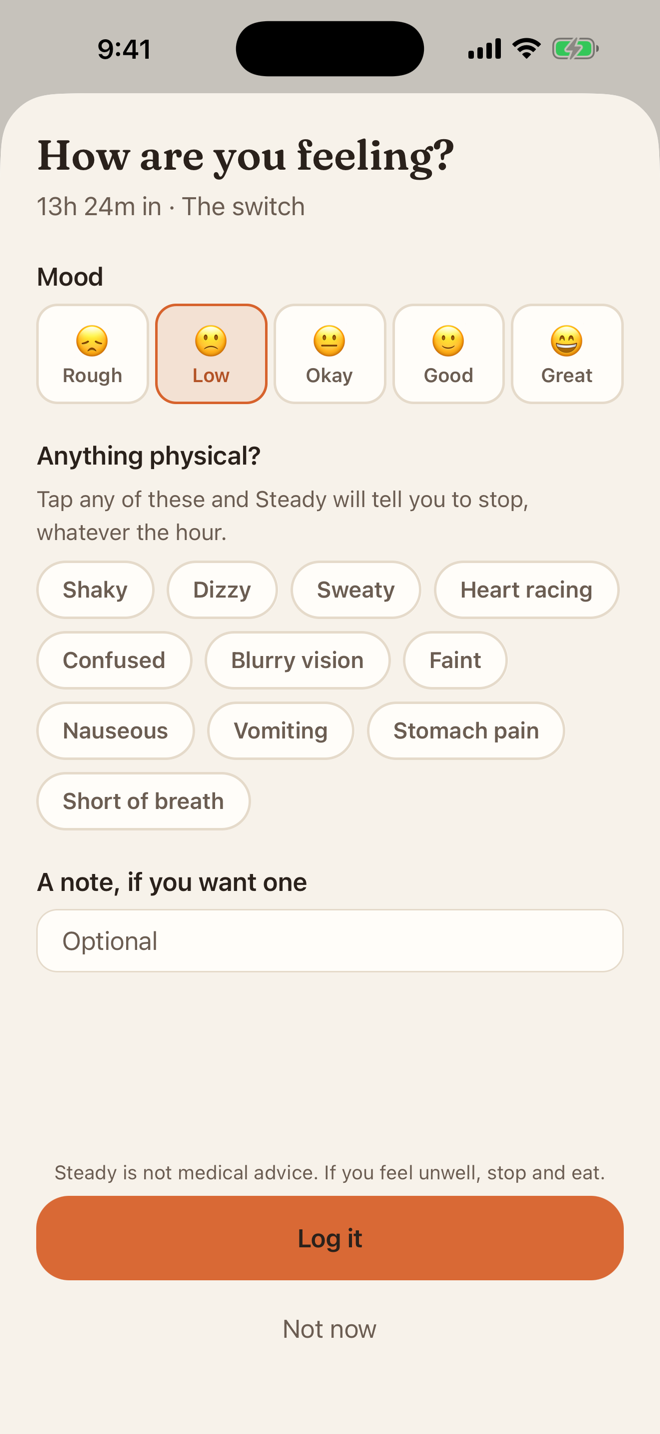
It also lifts. That is the part you cannot see from inside it, and it is the reason Steady asks you to rate your mood when it is bad and again two hours later. After a few fasts you are not being told that it passes, you are looking at your own record of it passing.
Light-headed, cold, and sleeping badly
A brief head rush when you stand up fast is common and passes in a few seconds. Feeling cold in the hands and feet in the back half of a long fast is common too. Sleep often gets worse in the first week and better after that, and finishing your last meal earlier tends to help more than anything else on this list.
The distinction that matters for all three: does it pass when you sit down and wait? A head rush that clears in seconds is ordinary. Dizziness that is still there a minute later, while you are sitting still, is not, and is one of the reasons to eat.
Uncomfortable, or unwell?
This is the only part of the page worth memorising.
The two lists
Left: sit with it for twenty minutes. Right: eat now, whatever the timer says.
Uncomfortable
- Hunger that comes and goes in waves
- A mild headache
- Feeling flat, bored or irritable
- Cold hands and feet
- A head rush that clears in seconds
- Thinking about food constantly
Eat now
- Shaky, sweaty or clammy
- Dizzy while sitting still
- Confused, or struggling to follow a sentence
- Heart racing or pounding
- Blurred or dimming vision
- Close to fainting
Most of this is the first two weeks talking
The shape below is the one people describe most often: fine on day one, worst somewhere around days two to four, then a slow slide into unremarkable. It is not a promise, and plenty of people have a bumpier version of it. But it is the reason "give it two weeks" is the most common piece of good advice in fasting, and the reason quitting on day three tells you almost nothing about whether fasting suits you.
How much you notice side effects, first two weeks
The pattern most people report on a steady 16:8 schedule.
How much you notice it
What actually helps
- Drink earlier than you think you need to. Most fasting headaches are a water and salt problem wearing a scary costume.
- Keep caffeine on its normal schedule. Moving the food is one change. Moving the coffee at the same time is two, and the second one is the one that gives you a headache.
- Eat enough in the window. A shorter eating window is not a licence to eat noticeably less than your body needs. Plenty of "fasting side effects" are just under-eating with a nicer name.
- Take two hours off before you take the whole thing off. A 14-hour window you keep beats a 16-hour one you quit. Nothing about 16 is magic.
- Do not stack a new fast on a bad night's sleep. Tiredness makes every other item on this page louder and is the most reliable way to turn a manageable afternoon into a quit.
- Name the loudest of the three. When it hits, work out whether tired, hungry or low is actually in front. Hunger answers to water and twenty minutes, tiredness to a short walk or lying down, low mood to company or a change of room. Treated as one lump, the stack is unbeatable; taken apart, it is three ordinary problems.
Questions people ask
What are the most common side effects of intermittent fasting?
Hunger that arrives in waves, headache, irritability, trouble concentrating, feeling cold, and a head rush when you stand up. Sleep is often worse in the first week and better after that. Almost all of it belongs to the first two weeks and settles as your body gets used to the new meal times.
Why do I get a headache when I fast?
Usually three things at once: less water, because a lot of your fluid normally arrives in food; less salt, for the same reason; and caffeine landing at a different time than your body expects. Drink more than feels necessary, keep coffee on its usual schedule, and if your doctor has not told you to limit salt, a pinch of it in water often helps within the hour.
Is it normal to feel dizzy while intermittent fasting?
A brief head rush when you stand up quickly is common and passes in seconds. Dizziness that stays while you are sitting still is not the same thing, and it is a reason to eat now rather than wait for the timer. Confusion, fainting, a racing heart or blurred vision mean eat immediately and talk to a doctor.
How long do intermittent fasting side effects last?
For most people the worst is days two to four, and by the end of the second week the same fast feels noticeably easier. If nothing has improved after three or four weeks, the window is probably too long for your life rather than your body being slow, and taking two hours off it usually works better than pushing on.
When should I stop a fast and eat?
Whenever you feel unwell rather than uncomfortable. Shaky, sweaty, confused, faint, a pounding or racing heart, blurred vision, or dizziness that does not pass when you sit down: eat, and do not wait for the clock. Ordinary hunger, a flat mood and a mild headache are uncomfortable, not unwell, and those are the ones worth sitting with for twenty minutes.
Get through the hard hours.
Steady is an intermittent fasting coach app for iPhone. It works out which hour tends to beat you, checks in just before it, and tells you to eat when you should. Your data never leaves your phone.
Free while it is in beta. Tell us what breaks, and we will let you know when Steady reaches the App Store.